 Rock Dance International
The four fundamentals of Up Rock
Up Rock rests on four fundamentals. Three are moves: the freestyle, the jerk and the burn. The fourth is the formation rockers battle in, the Apache Line. Here is each one from zero, and how they fit on the record.
| Fundamental | What it is |
|---|---|
| Freestyle | Free dancing on the beat, between attacks |
| Jerk | The basic move: a sudden body movement on the music |
| Burn | The rocker’s own gesture, made out of the music, aimed at the opponent and never landing |
| Apache Line | Two facing lines of rockers, where the battle happens |
Freestyle, jerks and burns were, and still are, the three main movements of the dance. The battle runs in an Apache Line. The grouping in four is ours.
Freestyle
Freestyle is the free dancing on the beat between attacks. It is rocking without the burning.
You never dance it the same way twice, because it comes from feeling and expression.
Burning alone is not enough. A good burner still has to learn to freestyle and dance the record.
Jerk
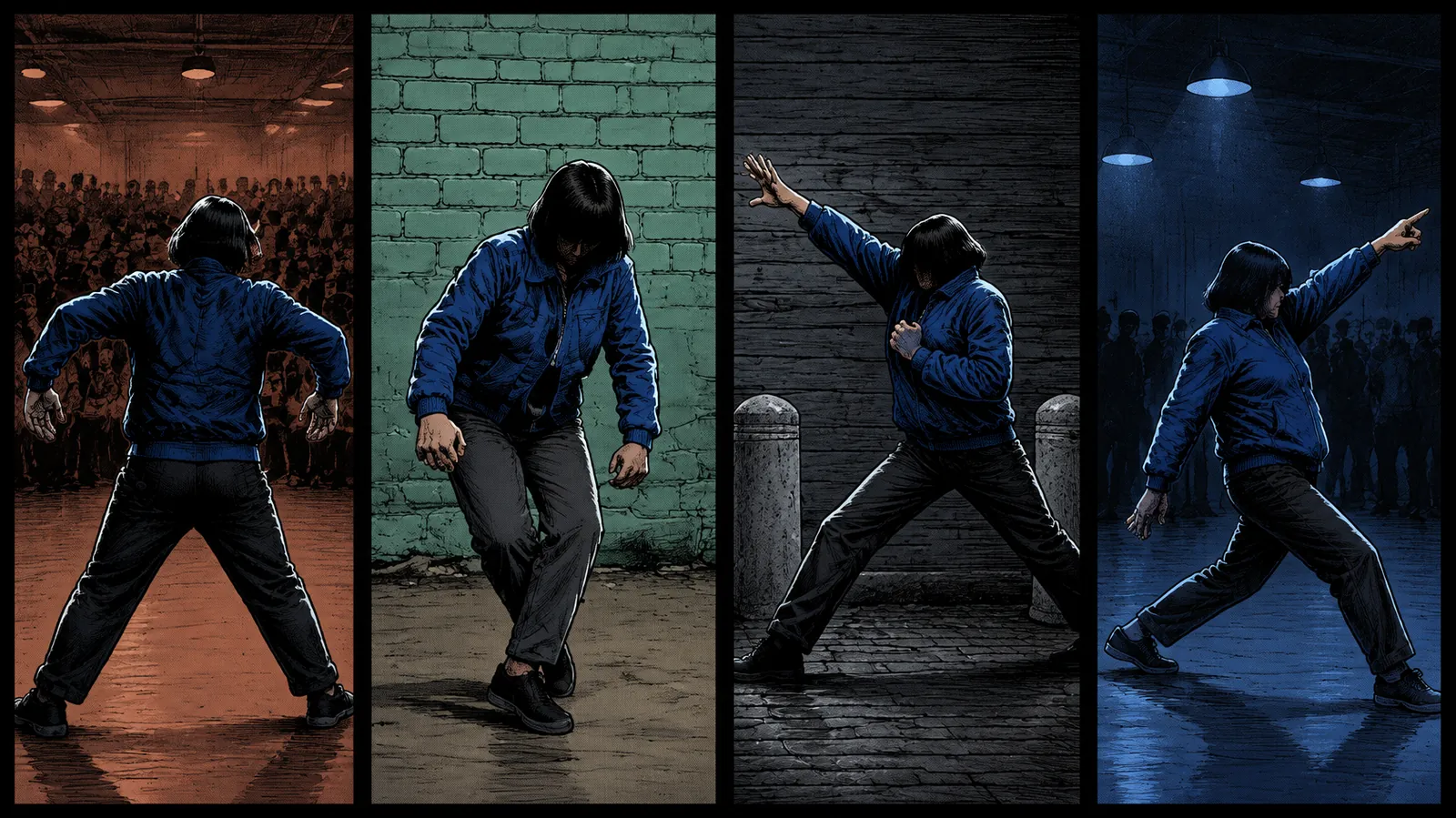
The jerk is the basic move: a sudden body movement. Back then, everybody who danced was doing jerks. Jerks have been described as moves that embody the 1-2-1-2-3 beat of funk.
The hard part is timing. A jerk lands on a moment of the record, and a jerk in the wrong place shows.
There are many kinds: the back jerk and the double jerk, power jerks, soft jerks and the bow jerk. Some rockers ask for full jerks, not quarter jerks.
More detail
Where the jerk came from is disputed. One account places it in Bushwick. One rocker dates the day he first saw it to October 11 or 12, 1974. Others say there were no jerks before 1976, or still none when they first saw the dance in 1975 or 1976. The history page places these dates on its timeline.
Burn
A burn is a gesture aimed at the opponent, and it never touches him. It can mime cutting him, stabbing him, shooting him down, breaking him in half. But a burn is much more than imitating a fight: it is each rocker’s gestural creativity. A rocker who knows the music deeply reads the record and interprets it with gestures of his or her own.
It does not have to be a weapon, though people sometimes think it must be a gun or a knife: taking out a comb and flicking it at somebody is a burn too. Anything a rocker learns from a sound or a word on a record can be turned into one. And it is still dance. A burn has to be done dancing. The rocker who wins is the one who does all of this best, not the one who throws the most weapons or humiliates the other with jokes or aggression.
Don’t do the same burn twice.
A burn is not a jerk, although a lot of people take the two for the same thing. A rocker known for his burns is a burner. The word is old street talk from the late 1960s and 70s, when people said they had burned or roasted someone.
Apache Line
The Apache Line is where the battle happens: two lines of rockers face each other, one rocker against another or crew against crew. Up Rock battles in a line where breaking battles in a circle.
Inside the line, the two opponents improvise on the music with freestyle, jerks and burns, with no physical contact. Each rocker holds his place until a crewmate taps him on the shoulder to take over, or until the opponent gives out. The tap is a sign of respect for both rockers.
The Apache Line page covers how it runs, its rules and its origins.
How they fit on the record
A battle follows the record from start to finish.
On the break
The break is the instrumental or drum passage of a record, and in Up Rock it is the moment to attack. Some gangs even called the dance “the break,” because they waited for it to burn each other.
A Rocker must execute a jerk or burn at the “break” and dance freestyle or burn throughout the rest of the music played.
Between breaks
Until the break comes in, rockers freestyle. The rule allows burns there too.
The whole record
A rock battle lasts the whole record. Up Rock uses the music in its entirety, where breaking is a body in motion for the break of a song. That takes stamina. A record can run from three or four minutes to ten or fifteen, and rockers may go through several records in a row.
Rockers also act out the song and turn its lyrics and sounds against the opponent, using the music, a lyric or a sound to create the illusion of a story. On records without lyrics, the sound effects are the cue to follow. The music page covers the records rockers name.
Burn or get burned
There are no set turns. Rockers improvise on the music from the first bar to the last, and a burn demands an answer: when someone burns you, you have to do something back to top his burn. Burn or get burned. Do not be afraid to burn and get burned.