 Rock Dance International
Acting out the song
Dancing to the words and sounds of a record as well as its beat, so the moves mime what the song says. On records without lyrics, the little sounds lead the dance.
The words of Up Rock, from the jerk and the burn to the Apache Line, each explained in a line or two for someone who has never seen the dance.
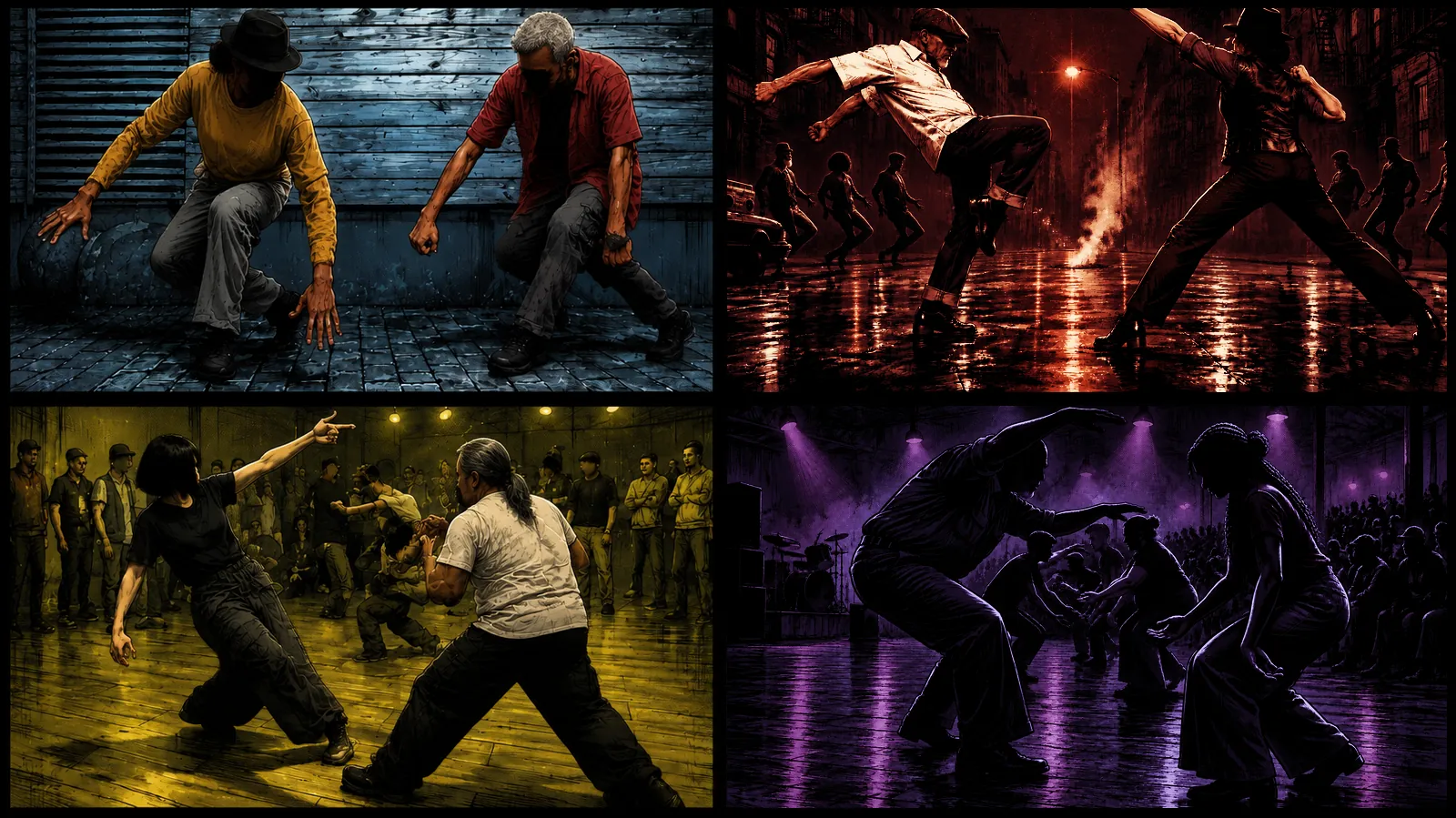
Rocking comes down to three moves: freestyle, jerk and burn. Where rockers disagree on a word, the entry says so. For how the moves fit together, see the fundamentals; for the dance as a whole, What is Up Rock?
Dancing to the words and sounds of a record as well as its beat, so the moves mime what the song says. On records without lyrics, the little sounds lead the dance.
The battle formation of Up Rock: two lines of rockers facing each other, one rocker against another or crew against crew.
Uprockers battle throughout the duration of a complete song (from the beginning to the end) in a line formation called the “Apache Line”.
The line is traced to a gang initiation, where a new member had to pass it; at contests it kept each rocker on his own side, without touching. The Apache Line page shows how a line runs.
A breaker. Up Rock veterans disagree on what the word first meant and on whether it covers rockers. Some remember it first meaning a thug or a stick-up kid. This site calls Up Rock dancers rockers.
A crew battle in which the losers gave up their crew shirts. Losing your shirt could mean losing your nickname and your crew’s name. See colors.
A record suited to a rock battle, as distinct from one for a cypher or for breaking. The records are on the music page.
To copy another dancer’s moves, style or name. Someone who copies is a biter.
The instrumental or drum passage of a record. In Up Rock it is the moment to hit a jerk or a burn.
A Rocker must execute a jerk or burn at the “break” and dance freestyle or burn throughout the rest of the music played.
The long break at the end of a record is sometimes called the super break. See also whole record.
A name for the dance used outside Brooklyn, sometimes cut down to just Brooklyn. Some Brooklyn rockers reject the label and just call it rock.
The rocker’s gesture aimed at the opponent, made with the hands or the whole body and taken from the music. It can mime a cut, a stab, a shot, a body broken in half, but what counts is the creativity: how the rocker reads the record and interprets it. A burn calls for an answer, and it still has to be danced.
A rocker known for burns. Burning alone does not make a dancer: a rocker can outburn an opponent and still be outdanced.
To challenge someone in public to a battle. See also show and prove.
The shirts, jackets or vests that carry a crew’s name, a custom taken from the gangs. At first, crews could not wear colors because of the gangs. See battle for shirts.
A named dance group. In Brooklyn the crews took over the structure of the gangs before them, with local chapters or divisions, tryouts, rivalries and truces. To get in, you could have to dance against one of the crew’s top dancers.
A judge’s crossed arms, calling a tie that sends the rockers back for one more record.
An informal circle of dancers, outside any contest and with no judges. Brooklyn rockers battled both on the lines and in the cyphers.
To humiliate an opponent with burns. Rockers also say rank on, roast and kill.
A jam with a one-dollar entry, first held in the 1990s. The price was set so that families could afford it. The history page places the Dollar Jams in the story of the dance.
Rocking done on or near the floor. Also written downrock, and called floor rock or floor rocking. What the word covers is disputed; the Up Rock vs toprock page compares the terms.
A dip or fall toward the floor, one of the parts of the dance along with the freestyle, the jerk and the spin. The line between a drop and a jerk is blurred.
A showcase battle agreed in advance, with no contest and no judges.
The name of a rhythm that uprocking is danced to, according to one written source. None of the rockers in our sources explains the term.
The free dancing between attacks: steps, shuffles and turns on the beat, without burning the opponent. It is the first of the three moves of rocking, with the jerk and the burn. You never dance it the same way twice, because it comes from feeling.
In the contests of the 1970s, a contest for pairs dancing prepared routines, held apart from the one-on-one rock battle. See also routine.
A Latin club music genre of the 1980s, unrelated to the freestyle part of the dance. With it, breaking was pushed off the club floors.
A jerk taken all the way down, driven from the hips. Its opposite is the quarter jerk, which stops short.
A wave of rockers. The veterans number the generations, but each account draws the lines in a different place. In one count, the first generation danced from the late 1960s and the second came with the crews of the 1970s.
A dance party, and the place where battles happened. In the 1970s, DJs played break beats and crews battled crew against crew. Jams were also held in basements, and as hooky parties during school hours.
The basic move of Up Rock: a sudden movement of the body, usually a drop or squat toward the floor, hit on an accent of the music. There are many kinds, among them back, front, side and double jerks, and jerking at the wrong time of the record is a common mistake. Who brought the jerk in, and when, is disputed.
The title of Ralph Casanova, tied to a 1980 contest in Bushwick that decided the number one rocker.
An early move that the sources name but never describe, like the shotgun. See also zipping.
The fight the dance can mime: punches, stabs and shots acted out against the opponent without touching. It is one side of the burn, not the whole of it. By some accounts the early dance was full contact. See no touching.
The rule that a rocker attacks without touching the opponent. A rocker who touches gets no point or burn. The rule came with the crews; before that, some rockers remember full contact, with the hand hitting the opponent’s chest.
A veteran of the first era of the dance, an elder by dancing experience rather than by age. The letters stand for original gangster. On the East Coast rockers also say old school, and younger rockers call themselves new school.
In the rockers’ speech, a member of a street gang. Rockers trace the dance to the outlaws, who burned right in your face until the crews brought in the no-touching rule.
A name one dancer uses for the hand gestures of rocking.
A jerk that stops short of going all the way down. See full jerk.
The return of rocking in the 1990s, when OG rockers were sought out and brought back to the scene.
To beat an opponent badly with burns. See also diss.
The first name of the dance, as many early rockers remember it, and a street word with several meanings. Off the dance floor, to rock someone, on a basketball court for instance, meant to beat them. See also rocking and Up Rock.
The name on the flyers for the dance competitions of the 1970s, which had one-on-one battles and contests for pairs or groups. The word rock confused rock music fans, who showed up expecting a concert.
A name for the dance that veterans remember from 1970s Bushwick, still used as another word for Up Rock. It could also mean the party itself, as in going to the rock dance.
A label for a leading rocker, recorded for the South Bronx of the 1970s.
Someone who dances the rock, with or without a crew. Also called an uprocker or up rocker. Rockers danced to be popular, as ghetto celebrities.
Dancing the rock, and one of the oldest names for the dance itself. Early breaking was often called rocking too. Labels such as jail rocking or latin rocking did not exist in the early days, when rockers just rocked, freestyled and burned.
A choreography prepared by a pair or a crew, danced in contests of its own, apart from the battle. See also freestyle contest.
A shake of the shoulders on the drum beat, as if trying to shoot them.
To prove yourself by dancing rather than by talking. See also call out.
A sliding step of the feet, part of the freestyle. Rockers also use the word critically, for breakers who shuffle and think they are rocking.
A jerk thrown to the side.
A touch on the shoulder that lets a crewmate take a rocker’s place in the line. The Apache Line page explains the relay.
To step in and dance all out. A dancer’s round can also be called a throw-down.
The steps b-boys and b-girls dance standing, in breaking style, before going down to the floor. It comes from rocking: rocking came first, and breaking dancers do its steps in a simpler form, because their complexity is on the floor. In Brooklyn, what others called top rock was called freestyle.
Three jerks in a row.
The later name of the dance first called rock or rocking, also written uprock, with the verb uprocking. Mistaken for a rock and roll dance, rocking became uprocking: the same dance with a different name. How and when the new name took hold is disputed, with dates from the early seventies to 1980-81.
A battle in Up Rock, and the name events give to a category of its own, apart from breaking. The label “battle uprock” has been criticized as a European term.
A burn kept in reserve and pulled at the right moment of the record. The first attack is the one everybody watches.
The full length of a song, from start to finish, which is how long an Up Rock battle lasts. This sets rockers apart from breakers, and Brooklyn DJs blended and mixed rather than scratch just the break. A rocker needs the stamina for it.
A form of uprock named in a 1996 essay but not described. See also machete.