 Rock Dance International
The Apache Line in Up Rock
The Apache Line is the battle formation of Up Rock: two rows of rockers face each other and battle across the gap, one against one or crew against crew. Here is how it runs, its one firm rule and the stories of where it came from.
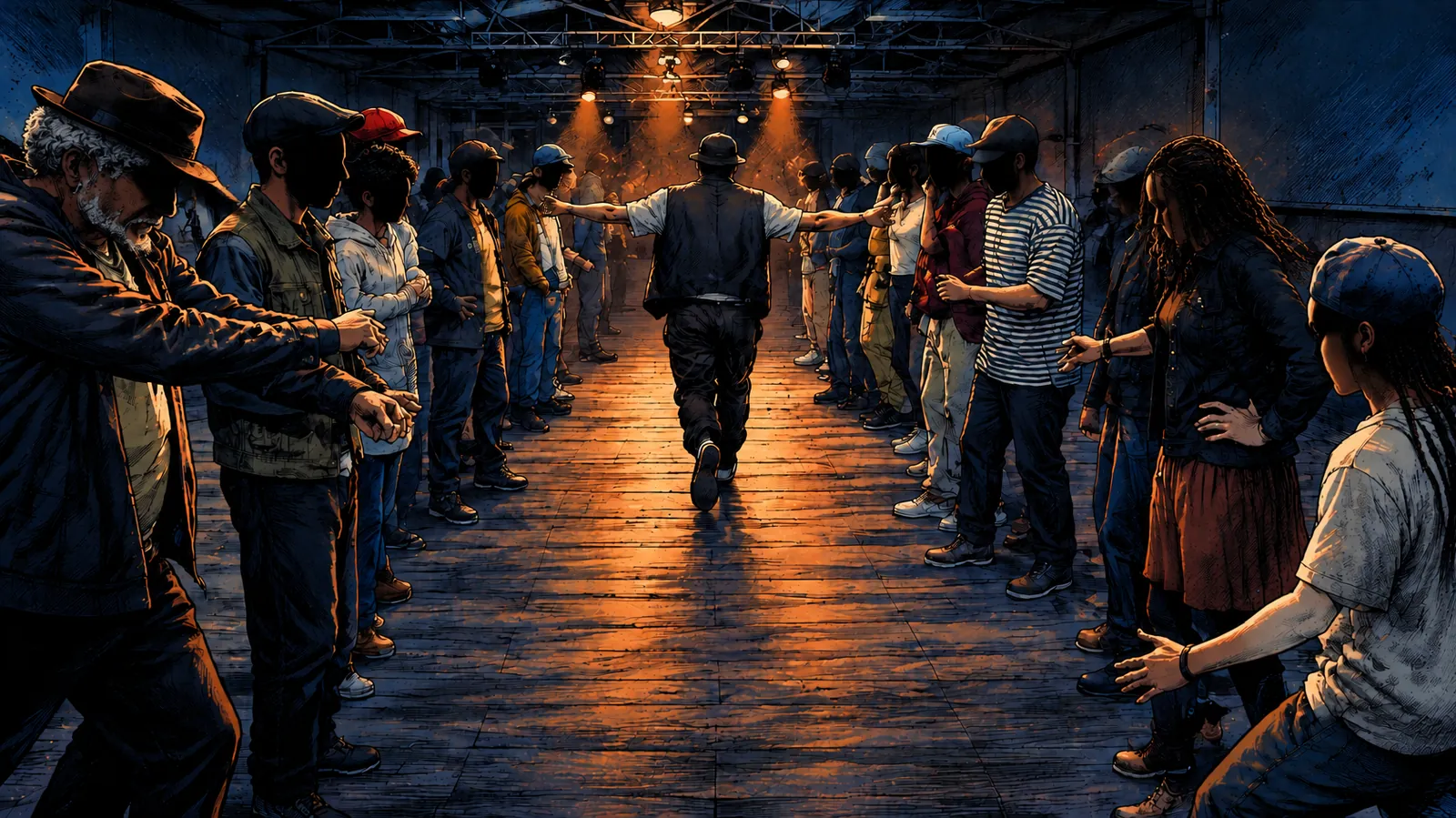
In uprock dance, the Apache Line is a battle formation. On this site the term never refers to line dancing.
What the Apache Line is
Two lines of rockers face each other, the crews on one side and their opponents on the other. A rocker battles the opponent straight across, or a whole crew battles another crew. Up Rock battles in a line where breaking battles in a circle.
Uprockers battle throughout the duration of a complete song (from the beginning to the end) in a line formation called the “Apache Line.”
The line was not the only setup: street battles were also performed face to face.
More detail
Nobody knows who first came up with the line, and accounts of its origin differ. Several tie it to a gang initiation, where a newcomer had to get through two rows of members. In one telling, the members hit him with chains and sticks. A single account says a promoter brought the line into the Brooklyn rock contests of the 1970s so that each rocker stayed on his own side, with no touching, because the line prevented fights.
How a battle in the line runs
- Line up. Two rows face each other, each rocker opposite an opponent.
- Play the whole song. The battle lasts the complete record.
- Follow the music. Freestyle or burns between breaks, a jerk or a burn on the break.
- Swap with a tap. A rocker holds his place until a crewmate taps him on the shoulder to take over, or until the opponent gives out. The tap is a sign of respect for both rockers.
The line also served to test a new member. The newcomer walks down the middle and battles every rocker of the crew, one after another, keeping discipline in his freestyle, jerks and burns. Going down the line battling is where you prove you can dance.
Lines could be long. Some contests of the late 1970s had over 50 rockers battling at once in one line. No source sets how many rockers a line should hold. One rocking magazine notes that the line now serves mainly as the preliminary round of rocking battles.
The moves themselves are on the fundamentals page.
The rules
No touching
Most accounts give one firm rule: no touching. Burns can look like punches or stabs, but they stop short.
Although Uprockers sometimes emulate fight moves with their “burns”, physical contact is never allowed.
A rocker who touches the other is given no point or burn, and contact is usually a sign of inexperience. Among the crews, as opposed to the gangs, you could not cross the line or touch each other. One account says rocking started as a full contact dance, with the hand hitting the opponent’s chest, and that this changed later.
Who wins
Who decides is less settled. One rocker remembers that back then everything was a crowd decision; another recalls a judge deciding the Apache Line by tapping shoulders. At one rocker’s first battle, the judges wanted the freestyle, the jerk and the burn.
One view holds that there is really no losing in the battle, since knowledge of the music and the styling of the dance are what win. Yet there were contests and titles, and crews battled for each other’s shirts.